
Background
One of the largest, privately operated electric distribution utilities in Southeast Asia, this company plays a critical role in powering urban and industrial growth across a densely populated and economically vital region. Despite its franchise area accounting for a relatively small portion of the country geographically, it delivers a disproportionately high share of the nation’s electricity output. With more than a century of experience, the utility is focused on advancing reliability, operational efficiency, and long-term sustainability in its power distribution network.
For over a decade, the utility relied on a mix of gas-insulated and oil-insulated switchgear from multiple manufacturers. While these solutions provided the necessary infrastructure to support its growing demand, they also presented challenges in terms of maintenance, scalability, and automation. Recognizing the need for modernization, the company embarked on a long-term strategy to automate its grid infrastructure. This transformation required a solution that could seamlessly integrate with existing assets while advancing toward a more sustainable and future- ready network.
The Challenge: Transitioning from Manual to Automated Grid Solutions
By 2018, the utility started the implementation of its Advanced Distribution Management System (ADMS) to improve grid intelligence and automation. Despite this progress, many critical components—including overhead reclosers, overhead switchgear, and underground manual switchgear—remained manual, limiting the full potential of the ADMS.
A major bottleneck in achieving system-wide automation was the presence of underground manual switchgears. The company needed a compact, fully automated solution that could fit within the footprint of its existing switchgear, avoiding costly redesigns and minimizing installation complexities. This presented a significant engineering challenge, as automation typically requires a larger footprint. Additionally, with the region’s flood-prone conditions, the new switchgear had to be fully submersible to ensure resilience during extreme weather events.
As part of its broader push to modernize operations and unlock the full potential of its ADMS platform, the utility developed a plan to upgrade legacy underground manual switchgear across its network. The plan emphasized automation, compactness, submersibility, and ease of integration with existing infrastructure. Once the specifications were defined, they invited several qualified vendors to propose solutions that could meet their requirements.
G&W Electric was among those evaluated. Following a pilot program in critical locations, additionally the utility assessed the performance of G&W Electric’s switchgear and automation system against their criteria. Based on this evaluation, they recognized the unique advantages of the solution—including its engineering fit, submersibility, and automation capabilities—and chose to expand its deployment.
The Solution: G&W Electric’s Compact, Automated, and Future-Ready Switchgear
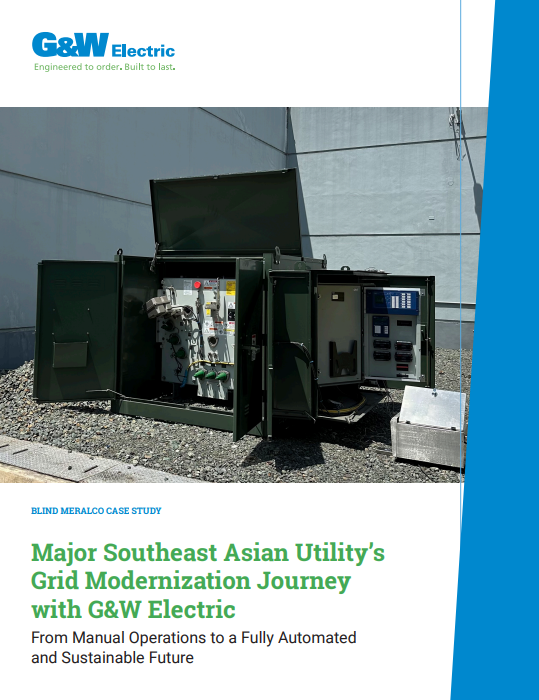
Following the evaluation and selection process, G&W Electric collaborated closely with their team to design a switchgear solution that met all technical, operational, and environmental requirements. The result was an innovative, compact, and fully automated switchgear system that seamlessly fit within the existing infrastructure without requiring expensive modifications. This ensured the utility could transition from manual to automated operations seamlessly, efficiently, and cost-effectively.
Beyond the compact and space-efficient design, G&W Electric’s switchgear also provided a fully submersible solution—a crucial feature given the region’s vulnerability to flooding. This enhanced resilience in extreme conditions, ensuring continuous operation even in challenging environments.
Another key component of the solution was the integration of G&W Electric’s Power Grid Automation system. This cutting-edge technology allowed the utility to transition from manual switching to a fully automated and remotely monitored system. Working in close alignment with the company’s forward-thinking automation team, G&W Electric’s distribution automation (DA) experts helped refine the switchgear’s configurations to meet the utility’s operational requirements. This integration allowed for real-time fault detection, remote switching, and automated service restoration—critical capabilities for enhancing reliability and reducing downtime.
Implementation and Growth: A Phased Approach
The transition to G&W Electric’s switchgear solution was implemented in a strategic, phased approach that allowed the utility to mitigate risks while ensuring a smooth integration with its existing infrastructure.
Phase 1: Pilot Deployment and Initial Testing
In 2021, during the height of the COVID-19 pandemic, the utility initiated a pilot program to evaluate automated PNI gas-insulated switchgear in the field. With a clear set of design expectations in mind, they developed a wish list of features they wanted to see in the automated switches, ranging from physical footprint and submersibility to integration with their existing automation system.
G&W Electric carefully studied these requirements and developed a custom-engineered solution that met all the utility’s critical functional needs and more. Seven units were installed in high-priority commercial and multi-unit metro locations, giving them the opportunity to validate the design’s performance and integration before proceeding with broader deployment.
Phase 2: Full-Scale Automation Rollout
Following the successful pilot, the utility expanded the deployment of G&W Electric switchgear across its network. The transition from manual to automated gas-insulated switchgear significantly improved reliability, reduced restoration times, and streamlined operations. The ability to remotely monitor and control switchgear in real-time meant that faults could be detected instantly, and power could be rerouted automatically, preventing prolonged outages.
By 2024, the utility had replaced approximately 40 gas-insulated switches with G&W Electric’s solution, accounting for 90% of its switchgear fleet. The utility’s decision to expand the deployment reflected their strategic commitment to scalable automation and the proven performance of the solution.
The Next Phase: Transitioning to Solid Dielectric for a Sustainable Future
Building on the success of its automation initiative, the utility is now taking the next step toward
sustainability by piloting G&W Electric’s Trident® solid dielectric switchgear. This transition aligns with
the utility’s broader goal of reducing its reliance on SF6 gas-insulated solutions, which have significant environmental implications.
Trident solid dielectric switchgear offers multiple advantages, including eliminating greenhouse gas emissions associated with SF6, reducing maintenance requirements, and further enhancing grid resilience. With the same configuration and automation schemes already in place, they can seamlessly integrate solid dielectric switchgear into its network without major infrastructure overhauls. By 2026, the company aims to have a fully sustainable solution implemented across its distribution network, reinforcing its commitment to both reliability and environmental responsibility.
Results & Impact
The transformation of the grid’s infrastructure through G&W Electric’s solutions has delivered significant benefits, both operationally and strategically.
The shift from manual to automated switchgear has dramatically reduced outage durations, improving service reliability and grid resiliency. Prior to automation, fault response times were significantly longer, requiring manual intervention and increasing restoration delays. Now, with real-time monitoring and automated switching, outages can be isolated and resolved in seconds rather than hours.
The integration of Power Grid Automation has also led to substantial operational efficiencies. With remote control capabilities, the utility can manage its distribution network more effectively, reducing the need for on-site interventions and optimizing workforce allocation. The scalability of the solution ensures that as the network expands, automation capabilities can grow with it.
Furthermore, by transitioning to the Trident solid dielectric switchgear, the utility is positioning itself as a leader in sustainable energy distribution. The adoption of environmentally friendly technologies not only aligns with global best practices but also supports the country’s broader sustainability goals.
Conclusion
The company’s decade-long partnership with G&W Electric exemplifies the power of strategic collaboration and continuous innovation. By embracing automation and planning for a sustainable future, the utility is not just modernizing its grid—it is setting a benchmark for utility transformation in the region.
Through a phased approach, the company has successfully navigated the challenges of automation and sustainability, demonstrating that even a historically manual system can evolve into a highly intelligent and resilient network. As the utility continues this journey, G&W Electric remains a trusted partner, providing innovative solutions that drive efficiency, reliability, and long-term success.


