
Resources
Case Studies
Every project starts with a problem the catalog can’t solve. See how utilities and commercial & industrial operators worked with our engineers to define the challenge, build the solution, and measure what changed on the grid.

17 results
Case Study
Utilities
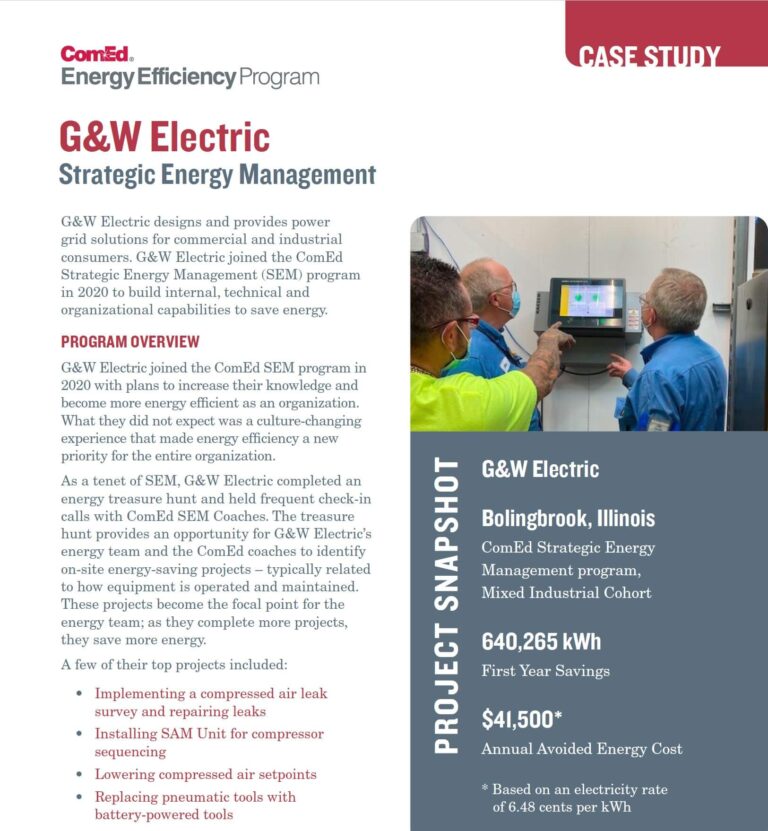
G&W Electric Strategic Energy Management
G&W Electric designs and provides power grid solutions for commercial and industrial consumers. G&W Electric joined the ComEd Strategic Energy Management (SEM) program in 2020 to build internal, technical and organizational capabilities to save…

Case Study
Utilities
How an Investor Owned Utility in Illinois Incorporated A Scalable Approach for Distribution Automation
CHALLENGE:Across the country, power outages are becoming the norm. Consequently, customers are growing increasingly frustrated, and more costs are being incurred by utilities, leaving them with no choice but to pass that cost along…

Case Study
Utilities
Underground Cable Transition Project
CHALLENGE:Continuous expansion of a major downtown city necessitated an upgrade of the electrical service by the utility company. The utility was faced with replacing the old substation equipment with new switchgear and associated apparatus.…

Case Study
Utilities
Three Phase Protection for Confined Space Applications
CHALLENGE:The utility serves approximately 95,000 residential and 13,000 commercial/industrial customers. Thedistribution system is 70% overhead and 30% underground. Nominal system voltage is 12.47kV transformed from a 34.5kV sub-transmission system. A new substation was required…
Case Study
Utilities
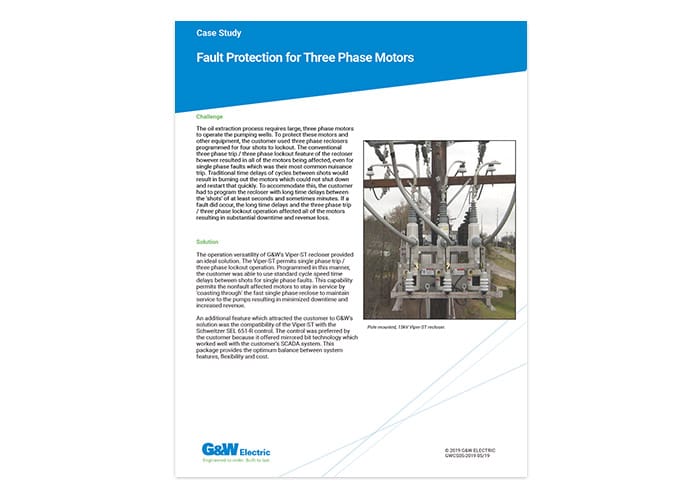
Fault Protection for Three Phase Motors
CHALLENGE:The oil extraction process requires large, three phase motors to operate the pumping wells. To protect these motors and other equipment, the customer used three phase reclosers programmed for four shots to lockout. The…
Case Study
Utilities
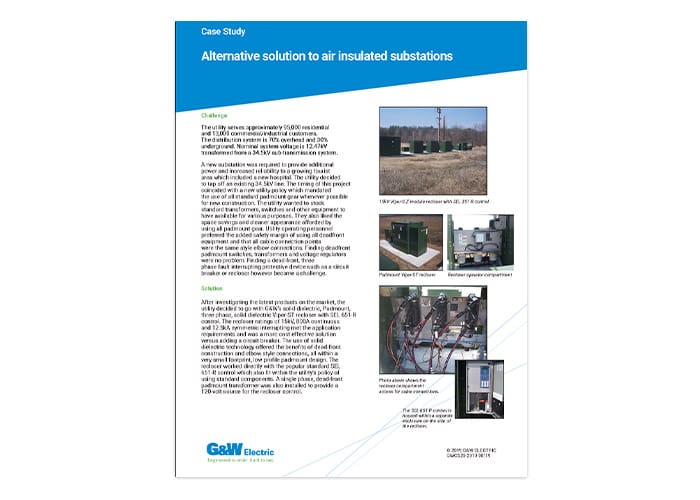
Alternative Solution to Air Insulated Substations
CHALLENGE:The utility serves approximately 95,000 residential and 13,000 commercial/industrial customers. The distribution system is 70% overhead and 30% underground. Nominal system voltage is 12.47kV transformed from a 34.5kV sub-transmission system. A new substation was…

Case Study
Utilities
Low Profile Recloser Solves Cluttered Pole Clearance Issue
CHALLENGE:The utility faced an extensive replacement project for many of their old, oil-filled reclosers. Many installation sites where replacement was necessary incorporated very congested utility poles where maintaining clearances was an issue. The utility…

Case Study
Utilities
Recloser Replaces Substation Breaker
CHALLENGE:The utility provides service to approximately 10,000customers in a primarily rural service territory of approximately 2,000 square miles. The utility needed to replace their aging circuit breakers, but wanted to leave the rack mounted…
Case Study
Utilities
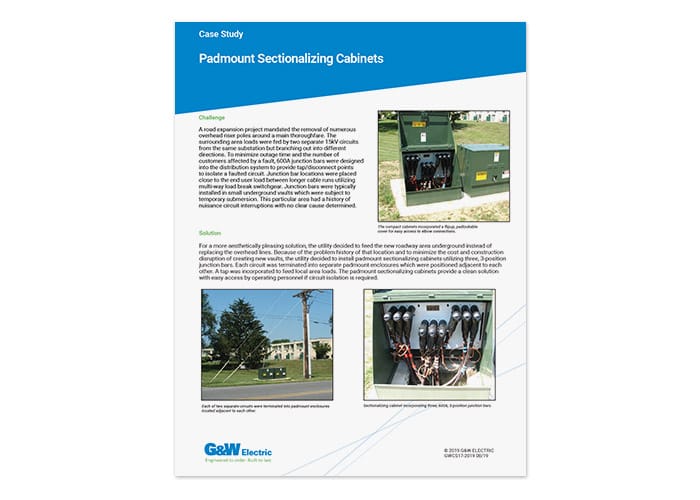
Padmount Sectionalizing Cabinets
CHALLENGE:A road expansion project mandated the removal of numerous overhead riser poles around a main thoroughfare. The surrounding area loads were fed by two separate 15kV circuits from the same substation but branching out…
Case Study
Utilities
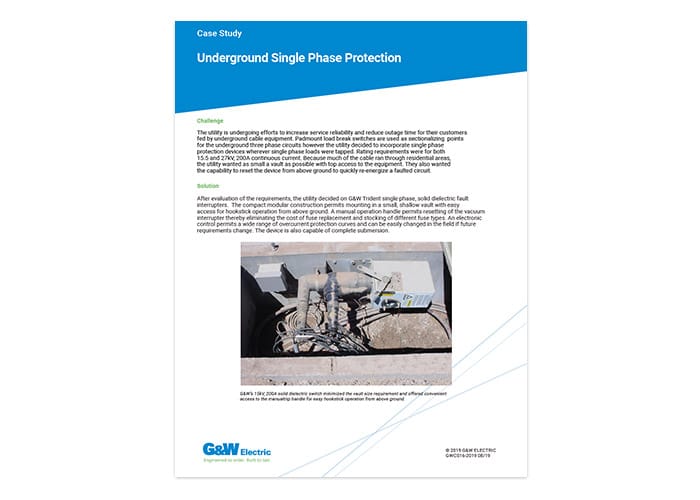
Underground Single Phase Protection
CHALLENGE:The utility is undergoing efforts to increase service reliability and reduce outage time for their customers fed by underground cable equipment. Padmount load break switches are used as sectionalizing points for the underground three…
Case Study
Utilities
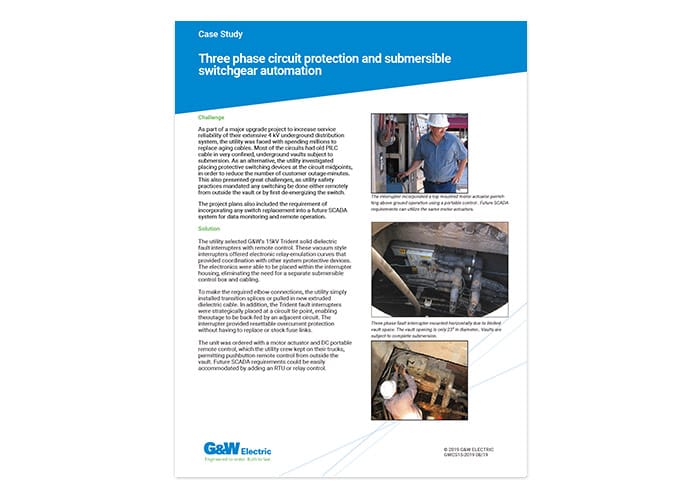
Underground Circuit Protection and Submersible Switchgear
CHALLENGE:As part of a major upgrade project to increase service reliability of their extensive 4kV underground distribution system, the utility was faced with spending millions to replace aging cables. Most of the circuits had…

Case Study
Utilities
Residential Automatic Feeder Restoration
CHALLENGE:A major Midwest utility has been focusing on automation to help assure reliable power to its customers. For years they have incorporated a SCADA system for transmission line and distribution substation monitoring. As a…
We start with the diagnosis, not the datasheet
Engineered to order means the specification comes from the site — footprint constraints, flood exposure, the automation platform already in service, the crews who will maintain it. Our application engineers work the problem with your team before anything is built.
These case studies are the record of that work: what was constraining the network, what was engineered in response, and what the utility measured afterward.
Engineered to order. Built to last.
Engineered for your grid, not off the shelf
Working through a footprint constraint, a submersibility requirement, or an SF6 transition of your own? Start with an application engineer, not a catalog.


